

The global construction sector continues to experience rising demand for high-grade plaster formulations, pre-mixed wall materials, and premium drywall substrates. Recently, a major international building materials manufacturer partnered with Hebei Lvjoe Machinery Manufacturing Group Co., Ltd. to engineer, fabricate, and commission a heavy-duty 100,000-ton annual capacity gypsum powder production line. The primary objective of this greenfield project was to establish a high-throughput manufacturing facility capable of converting natural raw gypsum rock and chemical synthetic gypsum into high-purity commercial plaster powder. Achieving this goal required overcoming several engineering hurdles, such as managing inconsistent feed moisture levels, minimizing thermal energy loss during high-temperature calcination, and maintaining precise particle size distribution across high-volume production cycles. To secure long-term operational stability, the client required a complete turnkey EPC solution rather than procuring isolated processing units from separate equipment suppliers.
To achieve a consistent annual output of 100,000 tons, the engineering team at Hebei Lvjoe Machinery deployed an integrated front-end preparation system tailored to the client’s local raw material composition. Raw gypsum rock is first delivered to a heavy-duty jaw crusher and secondary hammer mill to reduce feed size to below 20 millimeters. Automatically metered crushed rock then passes through a high-efficiency vertical grinding mill integrated with dynamic air classifiers. This continuous milling process ensures that fine gypsum particles reach an optimal fineness of 80 to 120 mesh. Automated gravimetric loss-in-weight feeders continuously transport the pulverized raw gypsum powder into the main calcination system. By controlling particle size uniformity early in the process, the production architecture minimizes mechanical wear on downstream equipment while ensuring balanced thermal exposure during the critical dehydration phase.
The core section of any modern gypsum powder production line is the thermal calcination system, where raw natural gypsum rock undergoes controlled thermal dehydration. For this 100,000-ton facility, Hebei Lvjoe Machinery integrated a proprietary fluidized bed ebullience calciner powered by a secondary thermal oil heat exchanger. Unlike conventional direct-fired rotary kilns that risk uneven scorching, the fluidized bed kiln utilizes low-temperature hot oil pipes embedded directly within the powder bed. High-pressure air blowers fluidize the gypsum powder, allowing each particle to absorb heat uniformly at operating temperatures between 150°C and 170°C. This gentle and precise thermal treatment ensures complete structural conversion into high-strength building plaster powder while preventing the formation of undesirable over-burnt or under-burnt impurities. For complete technical parameters of our automated machinery, explore our primary gypsum powder production line solution.
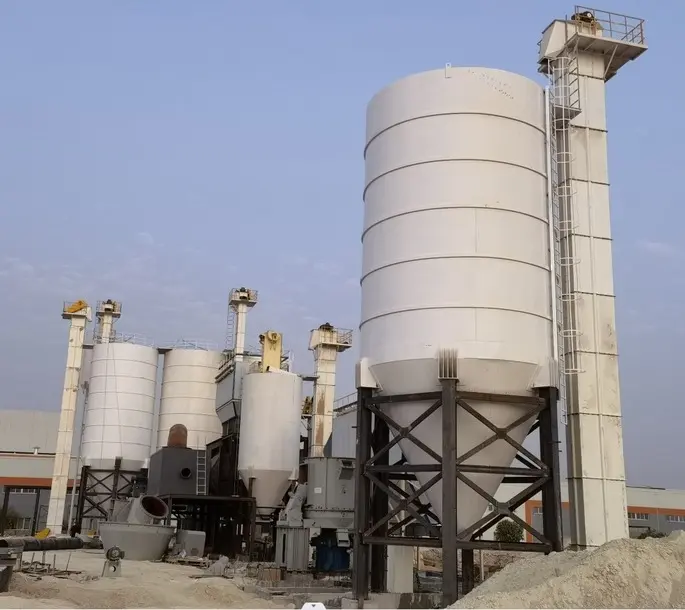
Thermal energy accounts for a significant portion of daily plant operational expenditures. To comply with modern ISO 14001 environmental benchmarks and lower net natural gas consumption, Hebei Lvjoe Machinery implemented a patented waste heat recirculation loop. High-temperature exhaust air vented from the fluid bed calciner is routed through secondary heat exchangers to preheat incoming raw gypsum powder and fresh process air. Furthermore, the entire plant operates under a centralized Distributed Control System (DCS). Field sensors continuously track real-time moisture, calcination temperature, pressure differentials, and material flow rates. Closed-loop communication protocols automatically adjust thermal oil valve positions and feeder motor speeds, ensuring consistent product quality with minimal manual oversight across 24/7 operating shifts.
Following rigorous physical assembly and site acceptance testing, the 100,000-ton gypsum powder production line reached full design capacity within three weeks of initial thermal ignition. Finished building plaster and casting powder samples successfully exceeded global quality specifications, including ASTM C28 standards in North America and EN 13279 European building standards for initial setting time, flexural strength, and purity. By partnering with Hebei Lvjoe Machinery Manufacturing Group Co., Ltd. for a full EPC execution, the project client realized a shortened installation schedule, measurable thermal energy savings of over 15%, and long-term diagnostic support backed by 24/7 cloud telemetry and priority spare parts availability.
Executing a complete turnkey 100,000-ton project—from preliminary civil architecture design and custom machinery fabrication to international shipping, physical erection, and DCS calibration—typically ranges between 5 to 8 months, depending on site readiness and environmental permits.
Fluidized bed calcination utilizes indirect thermal oil heating with forced air fluidization, ensuring uniform heat transfer at lower temperatures. This process prevents localized particle scorching, improves plaster quality, and consumes significantly less fuel compared to direct-fired rotary kilns.
The equipment engineered by Hebei Lvjoe Machinery is versatile and can process natural gypsum rock as well as synthetic industrial gypsum byproducts, such as desulfurization gypsum (FGD gypsum) from power plants and phosphogypsum from chemical processing.
Copyright © 2026 Hebei Lvjoe Machinery Manufacturing Group Co., Ltd. All Rights Reserved. privacy-policy

