

Establishing a new wallboard manufacturing facility requires investors and operational planners to balance upfront machinery capital expenditures (CAPEX) with long-term operational costs (OPEX). Building a modern gypsum board plant capable of supporting annual output targets ranging strictly between 2 million and 50 million square meters per year involves significant financial investment across machinery fabrication, civil engineering, electrical utility infrastructure, and environmental filtration systems. Drawing on decades of international engineering and project deployment experience at Hebei Lvjoe Machinery Manufacturing Group Co., Ltd., conducting a structured cost assessment early ensures predictable return on investment (ROI), prevents unexpected cost overruns, and secures project financing from institutional lenders.
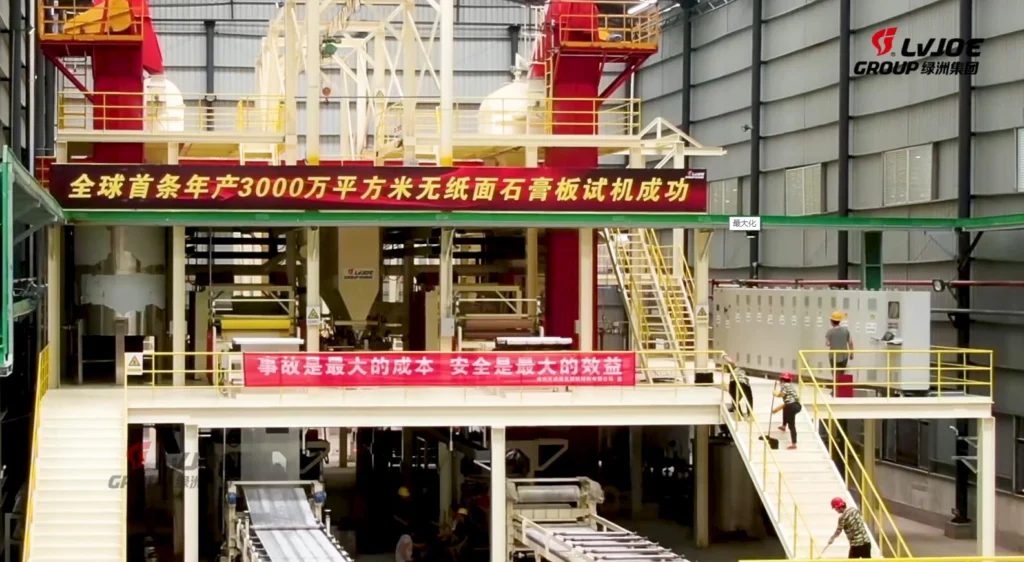
The single largest component of plant capital expenditure resides in the core production machinery. The continuous manufacturing sequence starts at the wet-end batching station, where calcined natural or synthetic gypsum powder, water, foaming agents, starch, and glass fiber reinforcement are precisely measured under Programmable Logic Controller (PLC) supervision.
High-shear slurry mixers distribute a uniform gypsum compound between continuous top and bottom paper liners on high-speed forming belts. Precision edge-forming equipment establishes exact panel thickness and tapered edge profiles in real time. Investing in robust, heavy-duty drive systems and automated mixing controls built by Hebei Lvjoe Machinery Manufacturing Group Co., Ltd. protects your capital expenditure by preventing material waste and ensuring 24-hour continuous operational reliability across the entire production line.
The thermal drying kiln accounts for the largest physical footprint and a substantial portion of machinery capital expenditure. Wet green boards emerging from the continuous cutting saw contain excess moisture that must be evaporated under strictly controlled temperature zones. Installing a multi-deck drying kiln equipped with dynamic temperature controllers ensures consistent moisture removal without scorching the protective paper facings.
Capital expenditure allocated toward advanced heat recovery systems delivers immediate operational savings. Modern kiln architectures feature automated heat exchangers that capture hot exhaust moisture, recirculating clean thermal energy back into the heating zones. According to industrial energy audits, integrating heat recirculation reduces total kiln fuel consumption by up to 30%, converting an initial machinery investment into long-term operational profitability.
Budgeting for a manufacturing plant extends beyond core machinery acquisition to encompass heavy industrial civil works, reinforced concrete foundations, high-voltage transformer stations, and centralized dust filtration systems. High-capacity continuous lines generate dynamic vibration and heavy static loads, necessitating reinforced slab foundations beneath forming tables, heavy drive assemblies, and multi-deck drying kilns.
Environmental compliance represents a mandatory capital expenditure component in modern industrial planning. Installing reverse-pulse baghouse dust collectors at material transfer points captures airborne particulates, protecting worker health and meeting stringent local air quality standards. Engineering teams at Hebei Lvjoe Machinery Manufacturing Group Co., Ltd. design custom plant floor layouts that optimize raw material handling, streamline internal forklift traffic, and facilitate seamless finished goods warehousing.
Final landed equipment costs include international ocean freight, marine transit insurance, specialized packaging, and technical on-site commissioning. Transporting heavy plant machinery across sea routes requires strategic cargo allocation across standard 40-foot High Cube (40HC) closed containers, as well as specialized 40-foot Open Top (OT) and Flat Rack (FR) units designed for oversized drive assemblies and heavy structural dryer frames.
To protect high-precision gearboxes, electronic sensors, and PLC control cabinets from ocean salt spray and tropical humidity, equipment manufactured by Hebei Lvjoe Machinery Manufacturing Group Co., Ltd. receives industrial Vapor Corrosion Inhibitor (VCI) anti-rust treatments. Sensitive electrical panels undergo hermetic vacuum sealing inside aluminum foil barrier bags packed with active desiccants. Upon site arrival, experienced installation technicians supervise foundation anchoring, precision laser alignment, sensor calibration, and cold-to-hot trial runs, ensuring the facility reaches full commercial output safely and efficiently.
Our complete wallboard production lines support annual output capacities ranging strictly between 2 million and 50 million square meters per year, customized to market demand.
While advanced multi-deck kilns with heat recovery systems require slightly higher initial capital investment, they reduce ongoing drying fuel costs by up to 30%, significantly accelerating the overall plant payback period.
Yes, Hebei Lvjoe Machinery provides turnkey engineering solutions, including 3D plant floor design, core equipment manufacturing, international sea freight packaging, on-site installation, and operator training.
Copyright © 2026 Hebei Lvjoe Machinery Manufacturing Group Co., Ltd. All Rights Reserved. privacy-policy

