

Manufacturing high-performance wallboard materials in Western Europe requires absolute adherence to rigorous environmental framework directives, carbon emissions trading schemes, and circular economy standards. When international building material producers deploy a heavy-duty plasterboard production line in countries like Germany, France, or the Netherlands, balancing operational profitability with zero-waste mandates is paramount. Contemporary facilities—engineered to support annual output capacities strictly between 2 million and 50 million square meters per year—must satisfy stringent industrial energy-efficiency criteria and dust emission caps. Drawing on decades of international EPC engineering and equipment design experience at Hebei Lvjoe Machinery Manufacturing Group Co., Ltd., integrating eco-friendly mechanical innovations allows European plant owners to reduce carbon intensity, comply with regional building mandates, and secure long-term market competitiveness.
As natural gypsum quarrying faces tightening environmental restrictions across Western Europe, modern plasterboard plants rely heavily on synthetic Flue-Gas Desulfurization (FGD) gypsum, phosphogypsum, and post-consumer wallboard waste. Operating a continuous facility with high proportions of recycled or synthetic materials requires precise chemistry control, as varying free-water contents and particle sizes directly affect mixing consistency.
Engineering teams at Hebei Lvjoe Machinery Manufacturing Group Co., Ltd. equip advanced production systems with automated loss-in-weight dosing feeders and specialized pin-mixer geometries. By continuously adjusting chemical retarders and water-to-plaster ratios based on real-time moisture feedback, the plant can process up to 100% synthetic or recycled gypsum without sacrificing board core strength or paper adhesion. This resource circularity lowers raw material procurement costs, prevents landfill waste, and secures valuable eco-certifications for green building projects.
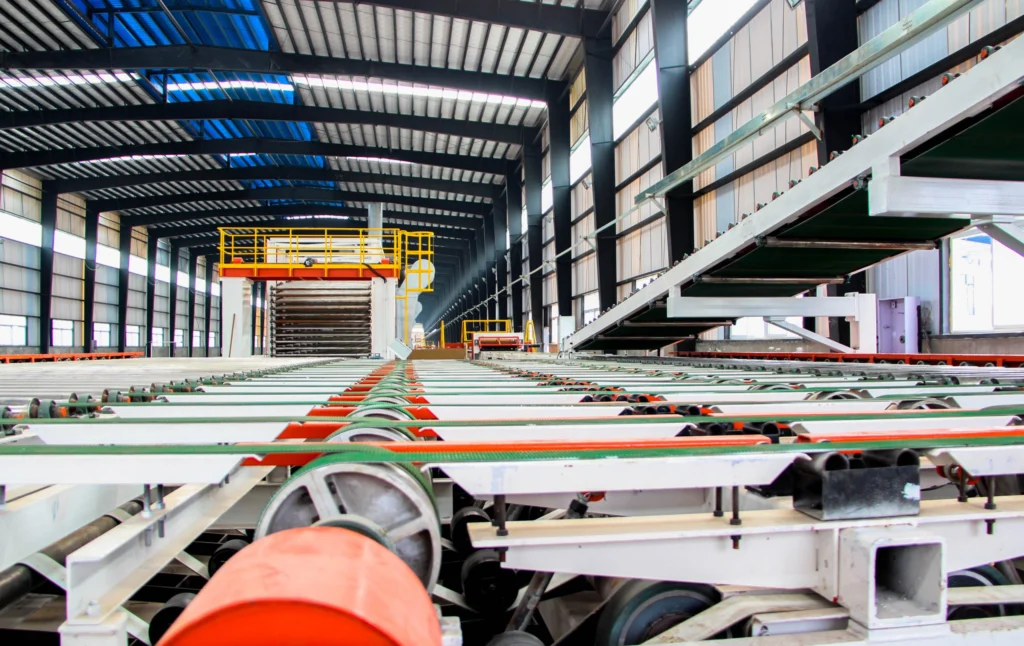
Drying wet-end wallboard sheets represents the largest source of thermal energy consumption and carbon emissions in any manufacturing facility. In Western Europe, where industrial gas prices and carbon tax tariffs remain significant operational cost drivers, outdated single-pass drying kilns are economically unsustainable.
Upgrading to a sustainable industrial design introduces multi-deck drying kilns equipped with closed-loop heat exchangers, dynamic zonal temperature controls, and multi-fuel low-NOx burners compatible with natural gas and green hydrogen blends. These systems capture moisture-laden exhaust air and recirculate clean thermal energy back into pre-heating chambers. This state-of-the-art thermal engineering reduces total fuel consumption by up to 30%, cuts atmospheric greenhouse gas emissions, and ensures uniform core moisture removal without surface scorching or edge cracking.
Achieving sustainable operations in Western Europe extends beyond thermal energy savings to encompass total water stewardship and air quality management. Industrial environmental regulations prohibit untreated process runoff and impose strict particulate matter thresholds on exhaust stacks.
Modern manufacturing lines incorporate closed-loop water treatment units that clarify and re-circulate process water from mixer washdowns and edge-trimming systems back into the main slurry batching tank, achieving zero liquid discharge. Simultaneously, continuous pulse-jet baghouse filters and negative-pressure ducting capture airborne gypsum dust across crushing, conveying, and cutting stations. Reclaimed dust is immediately fed back into the dry-dosing system, maintaining a dust-free plant environment while maximizing raw material efficiency.
Our sustainable wallboard production lines support annual output capacities ranging strictly between 2 million and 50 million square meters per year, tailored to European factory footprints.
Yes, our lines feature PLC-driven dosing and specialized mixing chambers engineered to handle variations in synthetic and recycled gypsum moisture and grain size.
Our plants integrate multi-deck heat recovery drying kilns, low-NOx combustion burners, and closed-loop water recycling, reducing thermal fuel consumption by up to 30%.
Copyright © 2026 Hebei Lvjoe Machinery Manufacturing Group Co., Ltd. All Rights Reserved. privacy-policy

