

Planning a capital budget for a new manufacturing facility requires investors to balance initial capital expenditures with long-term operational costs. Developing an automated facility with an annual capacity spanning strictly between 2 million and 50 million square meters per year involves multi-faceted financial planning across machinery procurement, site civil works, energy utilities, and ongoing raw material sourcing. Based on project engineering data established across global installation sites by Hebei Lvjoe Machinery Manufacturing Group Co., Ltd., establishing a clear financial roadmap early prevents budget overruns, secures institutional financing, and accelerates the operational payback period.
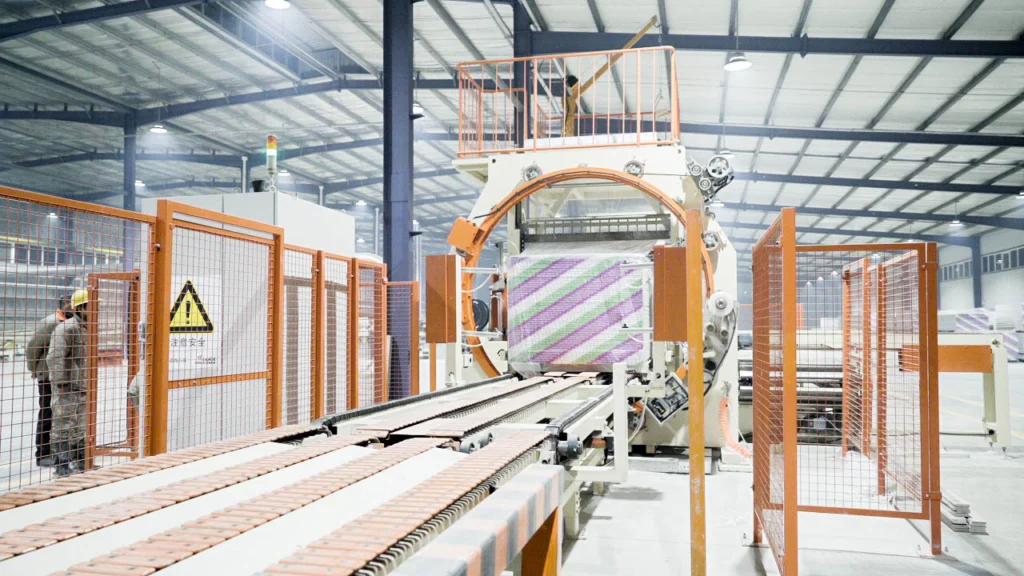
Primary machinery forms the largest single capital expenditure when establishing a modern wallboard plant. The continuous production sequence begins with automated raw material dosing, where calcined natural or synthetic gypsum powder mixes with water, foaming agents, starch, and structural fibers under precise Programmable Logic Controller (PLC) supervision.
Downstream forming belts deliver uniform slurry distribution between continuous paper liners, establishing exact thickness and edge profiles. The thermal drying section accounts for the largest physical footprint and mechanical investment. Multi-deck drying kilns featuring zonal temperature control and automated heat recovery capture exhaust heat, significantly lowering thermal energy costs. Dynamic transfer tables, cross-cut saws, board turners, and robotic stacking units complete the mechanical line. Equipment engineering teams at Hebei Lvjoe Machinery Manufacturing Group Co., Ltd. tailor machine specifications to target output demands, ensuring that every drive motor and gearbox delivers continuous 24-hour operational reliability. To review engineered plant configurations, explore our core plasterboard production line technology catalog.
Long-term profitability depends on securing cost-effective raw material supplies and optimizing energy utilization during continuous board calcination and drying operations. Natural gypsum rock, synthetic flue gas desulfurization (FGD) gypsum, or phosphogypsum byproducts serve as primary matrix inputs. While natural gypsum requires crushing and grinding equipment, FGD gypsum offers pre-refined purity that lowers upfront material processing expenses.
Paper liners constitute a major recurring operational cost. High-tensile face and back paper rolls provide structural rigidity, impact resistance, and moisture protection to finished wallboards. Thermal energy for drying kilns—fueled by natural gas, heavy oil, or coal-fired hot air furnaces—comprises up to 40% of ongoing operational expenses. Integrating automated heat exchangers and thermal circulation systems directly reduces fuel consumption per square meter of finished wallboard.
Budgeting extends beyond machinery acquisition to encompass site civil engineering, heavy-duty industrial floors, high-voltage electrical transformers, and industrial dust filtration systems. High-capacity manufacturing lines demand reinforced concrete slab foundations designed to absorb vibration and distribute static loads from heavy forming tables, heat exchangers, and automated board stackers.
Centralized environmental filtration systems are essential for workplace safety and regional regulatory compliance. Reverse-pulse baghouse dust collectors positioned at material transfer points capture airborne particulates, maintaining clean air inside the facility. Designing an optimized plant floor plan with dedicated raw material storage bays and finished goods shipping docks streamlines forklift traffic and improves overall factory throughput.
International freight, ocean transport insurance, and site installation represent crucial financial components of final landed equipment costs. Transporting an entire plant across sea routes requires strategic cargo loading across standard 40-foot High Cube (40HC) closed containers and specialized 40-foot Open Top (OT) or Flat Rack (FR) units designed for heavy drive assemblies and structural kiln frames.
To protect capital equipment against ocean salt spray, tropical humidity, and condensation, machinery undergoes rigorous surface preservation. Machined steel components receive industrial Vapor Corrosion Inhibitor (VCI) anti-rust coatings, while sensitive PLC control cabinets undergo hermetic vacuum packaging inside moisture-proof aluminum foil barrier bags packed with active desiccants. Technical specialists from Hebei Lvjoe Machinery Manufacturing Group Co., Ltd. direct on-site foundation anchoring, precision laser alignment, sensor calibration, and cold-to-hot trial runs, ensuring the facility reaches full operational output safely and on schedule.
Our complete wallboard production lines support annual output capacities ranging strictly between 2 million and 50 million square meters per year, customized to market demand.
Since thermal drying accounts for up to 40% of operational costs, multi-deck kilns equipped with automated heat recirculation capture exhaust heat to significantly reduce fuel usage.
Yes, Hebei Lvjoe Machinery offers complete turnkey solutions, including custom plant engineering, 3D floor plan layout, equipment manufacturing, ocean shipping, on-site installation, and operator training.
Copyright © 2026 Hebei Lvjoe Machinery Manufacturing Group Co., Ltd. All Rights Reserved. privacy-policy

