

In today’s fast-evolving global construction market, building material manufacturers face mounting pressure from rising raw material costs, shifting labor dynamics, and strict quality benchmarks. Transitioning a legacy wallboard facility into a fully automated drywall production line represents one of the most impactful capital investments a company can make. Engineered to support annual output capacities strictly between 2 million and 50 million square meters per year, modernizing manufacturing equipment transforms batch processing into an uninterrupted, high-precision continuous operation. Drawing on decades of international engineering and retrofit experience at Hebei Lvjoe Machinery Manufacturing Group Co., Ltd., upgrading to smart automation empowers plant operators to optimize raw material usage, eliminate operational bottlenecks, and achieve exceptional finished product consistency.
The foundation of consistent wallboard manufacturing lies in the continuous wet-end dosing system. Traditional, semi-automated facilities often struggle with batch-to-batch variations in gypsum slurry viscosity, foam bubble size distribution, and additive proportions. These inaccuracies lead to paper delamination, core density flaws, and excessive board edge trimming.
Engineering teams at Hebei Lvjoe Machinery Manufacturing Group Co., Ltd. integrate advanced Programmable Logic Controller (PLC) systems with high-accuracy flow meters and dynamic loss-in-weight feeders into retrofitted lines. By automatically adjusting water-to-gypsum ratios and chemical dosing based on real-time feedback, the upgraded manufacturing line maintains an optimal slurry density. This mechanical precision prevents raw material waste, ensures uniform core bonding, and drastically reduces finished board scrap rates to below 1%.
Drying represents the most energy-intensive stage of wallboard manufacturing. Legacy drying kilns with inefficient insulation or single-pass airflow setups consume vast quantities of thermal fuel, driving up monthly operating expenses and compressing profit margins.
Upgrading to an automated industrial system introduces multi-deck drying kilns equipped with closed-loop heat recovery exchangers and dynamic zonal temperature controls. These modern thermal enclosures capture moisture-laden exhaust air and re-circulate clean thermal energy back into the process chambers. This advanced airflow engineering reduces total kiln fuel consumption by up to 30%, lowers carbon emissions, and ensures uniform core moisture removal without surface scorching or paper charring.
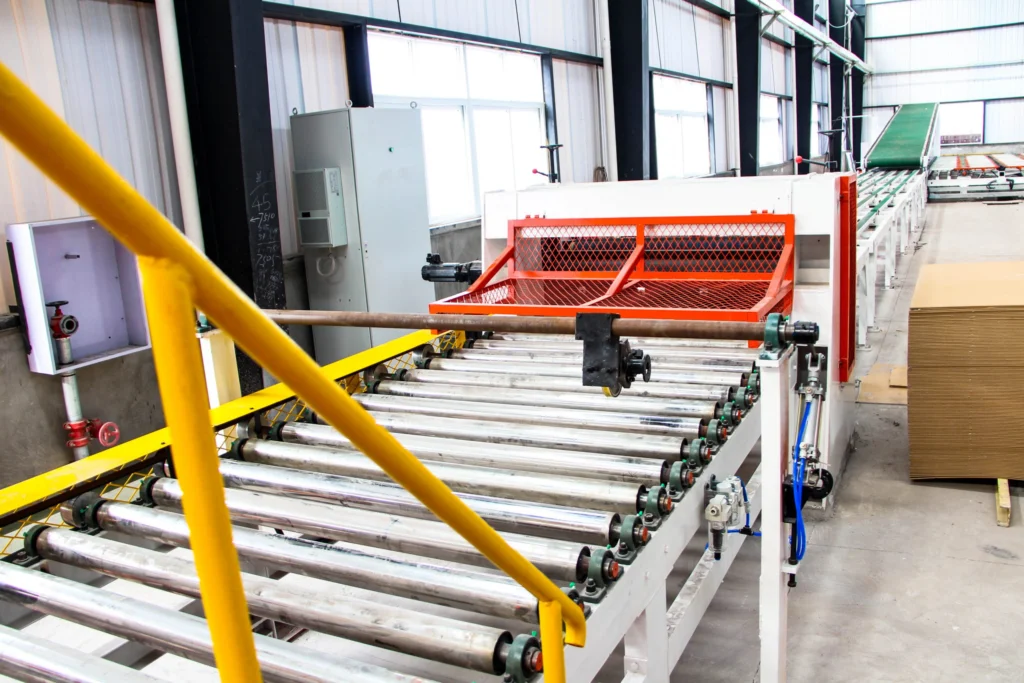
Physical bottlenecks frequently occur at the dry-end phase of legacy plants, where manual labor or outdated mechanical transfer tables struggle to match high-speed forming belt velocity. Slow handling leads to board collisions, corner chipping, and unexpected production stoppages.
Transitioning to an automated dry-end framework replaces manual stacking with high-speed servo-driven fly shears, automatic turn-over machines, and robotic palletizing stations. Synchronized seamlessly through central control software, the upgraded system ensures smooth board transfer, precise length trimming, and tight stacking alignment. This level of automation streamlines labor requirements, enhances workplace safety, and protects finished board edges, allowing the facility to run continuously at peak design speed.
Our retrofitted wallboard production lines support annual output capacities ranging strictly between 2 million and 50 million square meters per year, tailored to plant dimensions and budget.
PLC-driven dosing systems adjust water, slurry, and additive ratios in real time, maintaining consistent core density and reducing scrap rates below 1%.
Yes, our engineering team evaluates existing infrastructure to integrate usable heavy machinery, such as primary calcination or civil foundations, with new automated controls.
Copyright © 2026 Hebei Lvjoe Machinery Manufacturing Group Co., Ltd. All Rights Reserved. политика конфиденциальности

