

Establishing a commercial powder calcination facility requires a meticulous civil and structural design strategy long before the primary machinery arrives on site. When global building material producers install a heavy-duty plaster of paris making machine, preparing heavy-duty concrete foundations capable of supporting dynamic vibrating loads, fine grinding mills, and elevated vertical boiling furnaces is essential for operational longevity. Engineered to support annual output capacities strictly between 100,000 and 1,000,000 metric tons per year, modern powder processing plants generate significant mechanical torque and thermal expansion forces during continuous operation. Drawing on decades of international EPC engineering and factory architecture consultation at Hebei Lvjoe Machinery Manufacturing Group Co., Ltd., establishing precise foundation specifications prevents structural cracking, maintains equipment alignment, and guarantees safe 24-hour manufacturing.
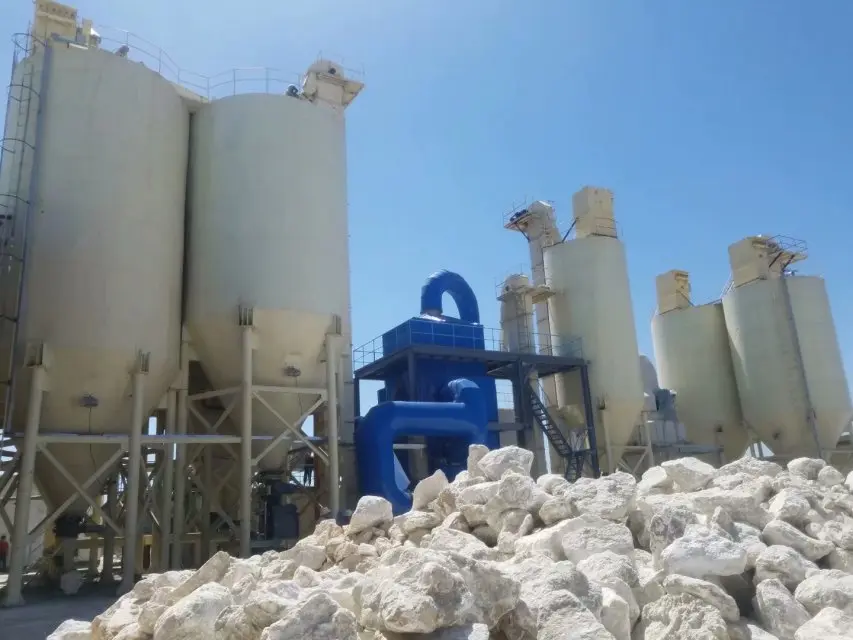
Operating high-capacity grinding mills, primary crushers, pneumatic conveying blowers, and automated fluidizing furnaces demands a stable, heavy-duty industrial power supply. Fluctuations in grid voltage or unexpected line power outages can stall fine Raymond or vertical roller mills under load, causing severe mechanical strain on drive gearboxes and costly production halts.
Engineering specialists at Hebei Lvjoe Machinery Manufacturing Group Co., Ltd. recommend deploying dedicated step-down transformer substations sized with a 20% to 25% safety overhead above peak operational load. Integrating variable frequency drives (VFDs) on high-torque crusher motors and primary exhaust fan blowers reduces initial startup current spikes, protects delicate PLC control cabinets, and cuts electrical power consumption by up to 15%. This electrical infrastructure framework ensures smooth motor acceleration, protects internal electronics, and supports uninterrupted continuous manufacturing across every operational shift.
The calcination phase represents the core thermomechanical process in converting raw dihydrate gypsum rock into high-purity plaster of paris (hemihydrate). Whether utilizing natural gas, heavy fuel oil, coal gas, or industrial steam, the thermal utility infrastructure must deliver continuous fuel flow and uniform temperature control to the boiling furnace or rotary calciner.
Modern facility layouts prioritize short, insulated natural gas or steam manifolds fitted with dual pressure-regulating valves and automatic emergency shut-off systems. Positioning fuel supply stations close to the central combustion chamber minimizes pipeline pressure drops and heat dissipation. Furthermore, heavy-duty stainless-steel exhaust ducts equipped with closed-loop heat recovery exchangers capture moisture-laden waste heat, recirculating clean thermal energy back into raw material pre-drying hoppers. This optimized thermal ducting design lowers total energy fuel consumption by up to 30% while maintaining precise dehydration temperatures inside the furnace.
Industrial powder manufacturing generates fine airborne particulate matter across raw rock crushing, grinding, calcining, and final bagging stations. To meet strict international environmental protection standards and ensure a safe workplace, the factory layout must incorporate an integrated negative-pressure dust filtration network.
Deploying high-efficiency pulse-jet baghouse dust collectors directly above material transfer points and storage silos ensures that fine plaster dust is captured before migrating into the surrounding atmosphere. Captured powder is automatically returned to the finished product conveying line via sealed pneumatic screw conveyors, maximizing raw material recovery rates to over 99.5%. Combining zero-discharge dust systems with enclosed pneumatic transport pipelines maintains a clean plant environment, protects operator safety, and guarantees full compliance with regional industrial environmental regulations.
Our heavy-duty industrial powder plants support annual output capacities ranging strictly between 100,000 and 1,000,000 metric tons per year, tailored to local market demand.
Foundation depth depends on local soil bearing capacity, but heavy grinding mills and vertical calciners typically require reinforced concrete pads rated for dynamic load factors.
We provide complete EPC engineering support, including foundation load diagrams, electrical single-line drawings, gas pipeline schematics, and on-site civil installation supervision.
Copyright © 2026 Hebei Lvjoe Machinery Manufacturing Group Co., Ltd. All Rights Reserved. политика конфиденциальности

