

Exporting a complete, modern manufacturing plant across international sea routes requires comprehensive engineering management long before containers arrive at the departure port. For commercial building material producers investing in an automatic production line for gypsum board with annual output capacities scaling from 2 million to 50 million square meters, maritime logistics represent a mission-critical phase that directly governs project installation schedules and overall operational readiness. Moving a full-scale plant involves transporting hundreds of tons of equipment, ranging from sensitive automated PLC control panels and precision optical sensors to massive multi-tier drying chambers, continuous mixers, and heavy hydraulic forming stations. Based on field-tested export protocols refined across global project installations by Hebei Lvjoe Machinery Manufacturing Group Co., Ltd., executing factory pre-assembly diagnostics, establishing modular breakdown schematics, and creating precise container loading maps ensure that complex machinery transitions safely from workshop floor to overseas foundation pads without structural distortion or costly port demurrage.
Optimizing cross-border freight costs for a large-scale manufacturing complex depends on strategic container allocation based on physical dimensions, total weight, and crane handling requirements. Standard 40-foot High Cube (40HC) closed containers serve as the primary workhorse for dense, standardized items, including liquid metering pumps, stainless steel piping manifolds, heavy rubber setting belts, and smaller mechanical drives packed inside ISPM 15 fumigated wooden cases. Central DCS automation cabinets, servo controllers, and optical field instrumentation are likewise allocated to 40HC units, where climate-sealed crates are secured to container floor rails with heavy-duty lashing straps and dunnage inflation bags to minimize vibration during ocean transit.
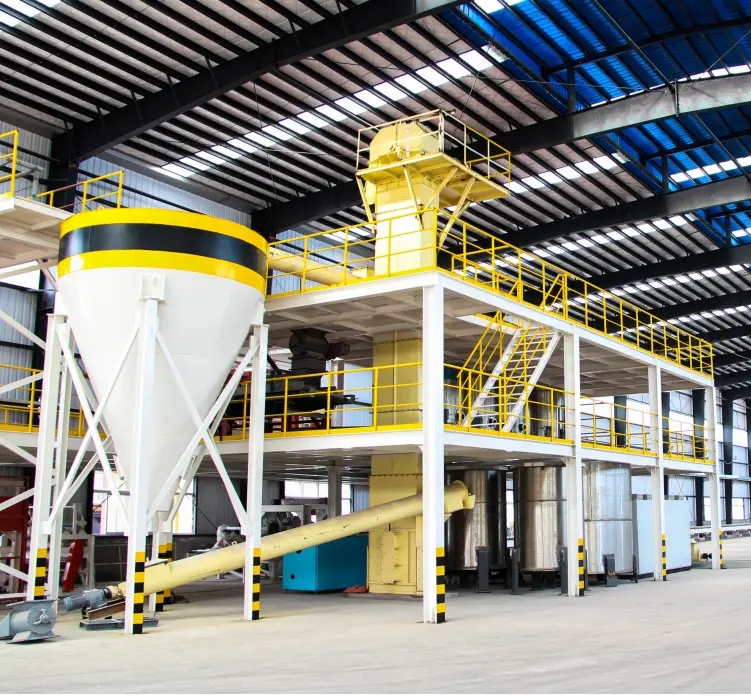
Conversely, out-of-gauge machinery modules require specialized open-top or flat-rack space to facilitate overhead factory crane transfers and specialized tie-down procedures. High-shear continuous mixing systems and heavy hydraulic forming stations are loaded into 40-foot Open Top (OT) containers, protected with industrial Vapor Corrosion Inhibitor (VCI) coatings, and covered with heavy-duty waterproof tarpaulins. Massive heat exchanger bundles, structural dryer frame sections, and raw material dosing silos are mounted on custom-engineered steel transport skids and secured onto 40-foot Flat Rack (FR) units using certified lifting lugs and high-tensile steel lashing chains. Engineering teams at Hebei Lvjoe Machinery Manufacturing Group Co., Ltd. custom-calculate weight distribution vectors for every Flat Rack assembly, guaranteeing total equilibrium during vessel pitching and port transshipment. To learn more about full plant engineering, modular layouts, and integrated machinery setups, explore our core automatic production line for gypsum board solution catalog.
Extended ocean voyages expose industrial machinery to aggressive environmental hazards, including salt spray, high ambient humidity, and severe temperature fluctuations inside vessel holds. To preserve machining tolerances, bearing surfaces, and sensitive electrical contacts across weeks at sea, factory logistics crews enforce rigorous multi-layer packaging protocols prior to container loading. Machined steel surfaces, such as forming rollers, cutter shafts, and drive gears, receive heavy coats of industrial VCI rust-preventative compounds that form a molecular protective barrier against surface oxidation.
Electrical control enclosures, operator touchscreens, and PLC automation modules undergo hermetic vacuum packaging. Technicians seal these units inside heavy-duty, moisture-barrier vacuum foil bags packed with active industrial-grade silica desiccants before mounting them inside heat-treated, ISPM 15 compliant wooden boxes. Heavy mechanical gearboxes, hydraulic pump units, and main electric drive assemblies are bolted directly onto reinforced steel transport runners. This rigid mounting framework prevents axial shifting during severe dynamic motion at sea, ensuring all components arrive at the destination seaport in pristine factory condition.
Seamless customs clearance at destination seaports relies entirely on absolute documentation precision and strict adherence to international maritime safety standards. Minor discrepancies between physical container manifests and customs declarations can trigger mandatory cargo holds, expensive port storage surcharges, and costly site installation delays. Logistics coordinators must compile itemized commercial invoices, certified bills of lading (B/L), certificates of origin, and comprehensive packing lists that explicitly define the net weight, gross weight, external dimensions, and exact container assignment for every individual crate.
Furthermore, acquiring full Institute Cargo Clauses (A) marine insurance provides indispensable all-risk coverage, safeguarding high-value capital machinery against transit damage, salvage contributions, or total loss during ocean passage. Implementing a multi-tier documentation audit before vessel departure streamlines customs clearance protocols, accelerating port release and keeping civil construction schedules on track.
Upon arrival at the destination seaport, logistics management transitions from ocean transit to heavy inland haulage and site offloading. Disembarking Flat Rack and Open Top containers requires certified mobile crane operators and multi-axle low-boy trailer trucks designed for concentrated weight distribution across regional road networks. Technical field specialists from Hebei Lvjoe Machinery Manufacturing Group Co., Ltd. provide local logistics contractors with detailed center-of-gravity rigging diagrams and lifting point schematics for every heavy crate. This thorough preparation eliminates structural distortion or tipping risks during crane transfers, ensuring all plant modules are positioned safely onto factory foundations, ready for rapid mechanical alignment, electrical interlocks, and DCS hot commissioning.
The total container count depends on annual production capacity, typically ranging from 15 to 35 containers for plants producing between 2 million and 50 million square meters annually, utilizing a strategic mix of 40HC, 40OT, and 40FR units.
DCS cabinets, PLC panels, and optical sensors are sealed inside airtight, heavy-duty vacuum barrier foil filled with active industrial desiccants and enclosed within ISPM 15 heat-treated wooden crates to block moisture and salt spray.
Yes, Hebei Lvjoe Machinery provides turnkey CIF (Cost, Insurance, and Freight) or DDP (Delivered Duty Paid) logistics management, handling container loading, export customs clearance, marine insurance, and site delivery coordination.
Copyright © 2026 Hebei Lvjoe Machinery Manufacturing Group Co., Ltd. All Rights Reserved. privacy-policy

