

Transporting a full-scale gypsum board plant across international borders requires rigorous logistical planning, precision load balancing, and secure industrial packaging. A modern manufacturing setup consists of large-scale core components, including raw material batching systems, long-forming belts, multi-deck drying kilns, edge-trimming saws, and automated stacking units. Standard production lines manufactured by Hebei Lvjoe Machinery Manufacturing Group Co., Ltd. range from an annual capacity of 2 million square meters to over 50 million square meters, meaning total cargo weight typically spans hundreds of tons. Shipping this high-value machinery safely across thousands of nautical miles demands a strategic balance between open-top containers, high-cube units, and flat-rack equipment.
Before any piece of equipment enters a shipping container, structured engineering planning determines how components are divided. Modern machinery design utilizes modular structural frames that allow large sections to separate safely without structural compromise. Each sub-assembly receives weather-resistant metal tagging and a corresponding digital loading manifest detailing total weight, volume, and balance points. Heavy components such as the primary mixing station, forming station rollers, and heavy-duty drying kiln heat exchangers are packed separately from sensitive electronic panels and hydraulic controls. Systematically labeling every pipe section, structural truss, and motor interface ensures seamless site assembly upon arrival at the destination port.
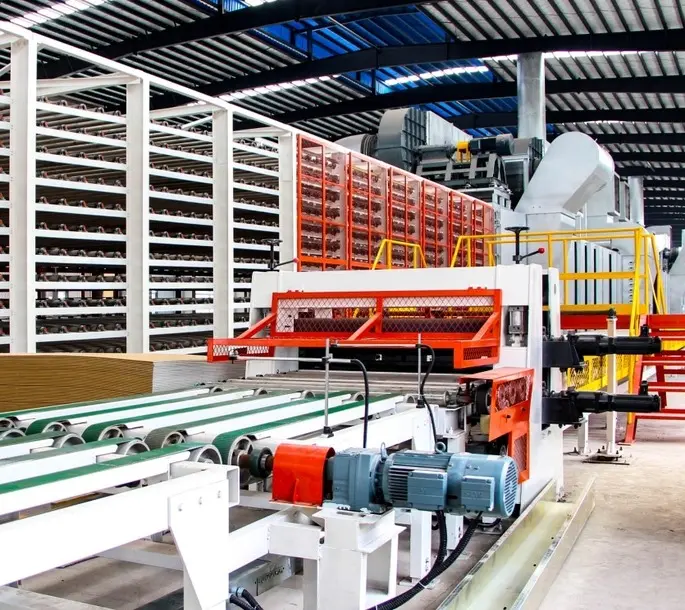
Optimizing ocean freight efficiency requires matching specific equipment geometry to appropriate ocean container types. Standard 40-foot High-Cube (40HQ) containers house the majority of long structural beams, frame trusses, ductwork, and modular enclosure panels. However, oversized components—such as large-diameter calcination kettles, heavy mixing tanks, and wide forming belt framework—exceed standard door dimensions. These items are assigned to Open-Top (OT) or Flat-Rack (FR) containers. Utilizing specialized tarps and heavy-duty lashing straps on flat-rack units prevents exposure to ocean salt spray, keeping sensitive mechanical surfaces fully protected throughout international transit. To explore modular plant layouts engineered for global shipping, review our core gypsum board plant technology catalog.
Maritime transit presents severe atmospheric challenges, including continuous salt air exposure, rapid thermal fluctuations, and ambient humidity condensation inside closed metal containers. To safeguard high-precision machined surfaces, gearboxes, and exposed drive shafts, technicians apply specialized anti-rust coatings, heavy grease barriers, and vapor-corrosion-inhibitor (VCI) films before securing components in heat-treated wooden crates. Electrical cabinets, PLCs, and touchscreen interfaces undergo vacuum-sealed aluminum foil wrapping packed with industrial-grade desiccant bags. This multi-layered barrier protection prevents moisture ingress, guaranteeing that delicate control electronics arrive completely clean, dry, and ready for immediate installation.
Ensuring safety during sea transportation depends on effective weight distribution and internal container restraint systems. Uneven distribution of heavy steel components inside a container can lead to dynamic shift during rough sea conditions, risking damage to cargo and vessel infrastructure. Engineers calculate exact center-of-gravity placement for every container load. Steel machinery bases are secured directly to container floor D-rings using heavy-grade steel chains, turnbuckles, and high-tensile polyester webbing. Custom wooden chocks and welded steel stoppers are fastened into position around heavy bases to prevent lateral and longitudinal movement throughout ocean transit.
Smooth international transit relies as heavily on rigorous paperwork as it does on sound physical loading. Transporting complete manufacturing facilities across customs boundaries requires accurate export documentation, including detailed commercial invoices, itemized packing lists with harmonized system (HS) codes, certificates of origin, and comprehensive phytosanitary certificates for all wood packaging materials. Misclassified machine parts or missing wood heat-treatment stamps (ISPM 15 standards) can cause costly delays at destination ports. Technical specialists at Hebei Lvjoe Machinery Manufacturing Group Co., Ltd. ensure every shipping manifest complies strictly with customs regulations, avoiding unnecessary demurrage charges.
Upon vessel arrival at the destination port, logistics management shifts to inland transport and site offloading. Heavy-duty cranes and specialized forklifts move container units to the final factory site. Unloading procedures must follow a reverse-chronological sequence aligned with the installation master plan. Local engineering teams inspect external seals, verify crate integrity, and cross-check receiving lists against the original packing manifests. Staging machinery modules systematically on the factory floor near their designated installation points streamlines structural alignment, piping connections, and electrical wiring, ensuring an efficient transition from delivery to final commissioning.
Depending on annual capacity—ranging from 2 million to 50 million square meters—a complete plant typically requires between 15 and 60 containers, utilizing a strategic combination of 40HQ, Open-Top, and Flat-Rack units.
Electrical cabinets are thoroughly wrapped in vacuum-sealed aluminum foil packaging, paired with active industrial desiccants, and enclosed within ISPM 15 heat-treated wooden crates to block moisture and sea air.
All timber packaging, skids, and blocking materials must comply strictly with ISPM 15 standards, undergoing heat treatment (HT) and carrying visible official stamps to meet global customs regulations.
Copyright © 2026 Hebei Lvjoe Machinery Manufacturing Group Co., Ltd. All Rights Reserved. privacy-policy

